Nuclear Institute

Nuclear Institute: the CRM decision was theirs. Making it work was ours.
What happened when the CRM decision came first and the website had to follow, and why that order works.

At a glance
- Client:
- Nuclear Institute (NI), the professional body for the nuclear sector
- Sector:
- Professional membership body, engineering and science
- Client since:
- 2014
- CRM history:
- OMNET then Eudonet
- Highlights:
- Serving 5,500+ professionals across sectors from energy to defence and medicine to space, the platform runs on Umbraco, built and supported by us. In 2024, we concluded a full website-to-Eudonet integration — scoped journey-first and sandbox-proven before going live — alongside supporting integrations with NI's mentoring, referral, and digital badges platforms.
Where it started
The Nuclear Institute ran their membership on OMNET, the system that later evolved into Eudonet. When the time came to move, NI ran the decision internally and chose the new Eudonet platform on their own operational grounds. They didn't need us in the room, and we didn't have to weigh in on the decision. The website conversation came after, and that was our brief: make the web estate follow the decision, properly.
We mention the order because it matters, and because it's the right one. Your CRM is the operational heart of your association, and the choice of what runs it belongs to you, your team and your processes, not to a web agency's preferences. A website partner worth having doesn't need a vote. They need to be able to build well against whatever comes out of it.
NI told us the destination. We got to work.
Journeys first, code second
Working alongside both the NI team and the Eudonet team, we started where every good integration starts: nowhere near the code.
We scoped out NI's processes, mapped the touchpoints between the website and the CRM, and worked out the user journeys member by member, task by task. What does a member actually do, where does the data live, which system decides, and where does the answer get rendered? Only when the journeys held together on paper did the technical work begin.
The honest part
Then we met Eudonet's programming model, and we'll tell you plainly: we had never seen anything like it. Where most platforms present developers with entities by name, Eudonet speaks in tables, fields and catalogues identified by ID. It's the architecture that makes the platform so extendable, and it is genuinely disorienting the first time you meet it. It proved challenging at first, and anyone who tells you their first encounter with it wasn't is selling you something.
Two things got us through it fast, and both are worth naming because they're the real lesson of this project.
First, the Eudonet UK team were exceptionally supportive. They took the time to walk us through the programming model properly and the best approaches to take when integrating against it, rather than tossing us documentation and wishing us luck.
Second, Eudonet's full-featured Swagger endpoint meant we could prove every theory in the sandbox before committing a single line to real code. Every mapping, every workflow assumption, tested against a safe environment first. The learning curve was real, but it was navigated in a sandbox environment.
That's what de-risking an unfamiliar platform actually looks like. Not pretending the curve doesn't exist. Building the discipline that keeps mistakes in the sandbox instead of production.

The number we could have left out
We planned the integration at four months. It took nine.
Two things drove that, and neither was a mystery. The learning curve you've just read about was real, and we were climbing it for the first time. And Eudonet were building and customising NI's CRM while we were integrating against it, which meant parts of what we were connecting to were still taking shape as we connected to them.
We're publishing the number because it has become the most useful thing on this page. If you're planning a CRM change with a website integration attached, it carries two lessons.
First, sequencing matters. An integration against a CRM that's still being configured moves at the speed of the slower workstream. That's not a failure of either team, it's physics. Plan the overlap deliberately, or discover it expensively.
Second, the curve is paid once. Those nine months included the full tuition for Eudonet's programming model: the false starts, the sandbox experiments, the walkthroughs with the Eudonet UK team. That tuition was ours to pay, and it doesn't need paying twice.
The estate since
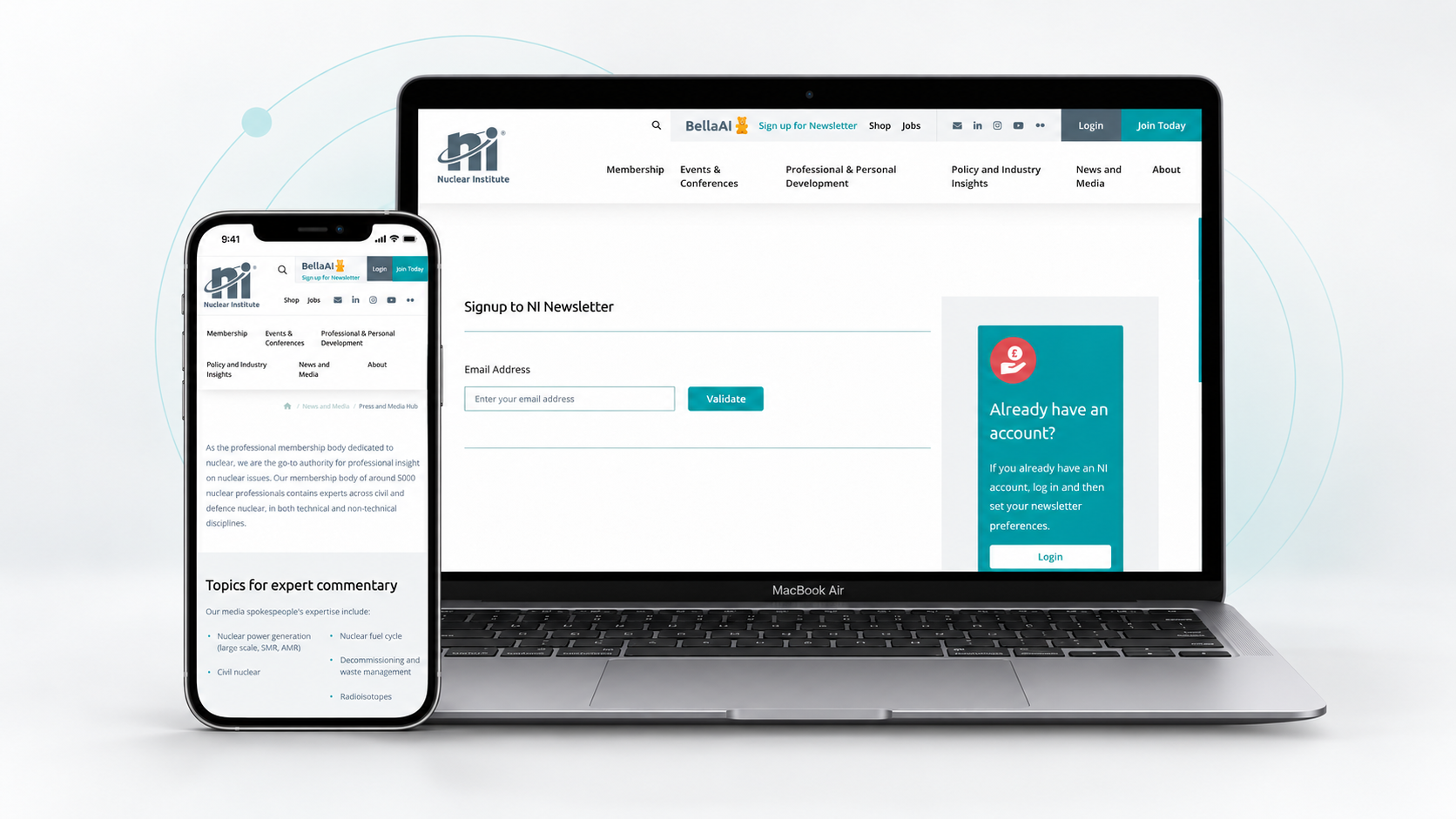
The integration was the beginning. We've since transitioned NI off the CMS they were running and onto our Umbraco CMS, and the estate has kept growing around the same principle: the CRM holds the truth, the website connects the dots.
Because a modern membership body is never just a website and a CRM. NI's 5,500-plus members, spread across everything from energy to defence, medicine to space, are served by a mentoring platform, a referral platform and a digital badges platform, and we've built the supporting integrations that connect each of them into the estate. One membership, recognised everywhere it needs to be.
A membership website, done right, is a junction. NI's is a busy one.

What this story proves
Three things. Your CRM decision belongs to you, and a good website partner makes it work rather than making it awkward. Unfamiliar platforms are mastered through honesty and discipline, journeys mapped first, theories proven in a sandbox, not through bravado. And vendor support quality is a genuine project factor: Eudonet UK's willingness to invest in our understanding shortened the road for everyone, most of all the client.
The Nuclear Institute remains a managed client today. Arriving after the big decision was made turned out to be no barrier to a long partnership. It rarely is.


How much should you spend on a website?
Try out our website cost calculator >


Website cost calculator
Roll your cursor over the scale or tap to select.